Perimenopause vs Menopause: What's the Difference?
Perimenopause vs Menopause — What's the Difference?
Perimenopause or menopause? Why is it so confusing?
If you discount the question: “why can’t I lose weight any more,” the next thing we’re asked about most is: “how do I know whether I’m in perimenopause or menopause?” And it’s not hard to see why. Up until perhaps 6–7 years ago, hardly anyone was talking about perimenopause. In fact, when we started coaching women in midlife, we were amongst the first people to start highlighting the different phases of a woman’s journey through midlife in what we started to call “the menopause transition”.
Since then, there’s been a huge explosion in information. And if you’ve ever done a search to find out what’s going on with your body or you’ve discussed it with a friend in earshot of your friendly phone or amazing Alexa voice speaker, you’ll have been served a heck of a lot more than you bargained for.
Most of the advice now out there is helpful and well-meaning, but some of it leaves a lot to be desired. Instead of being genuinely useful information, you can purchase all kinds of products that are said to be 'hormone balancing' (beware anyone promising to balance your hormones with a miracle supplement) and some that are, frankly, little more than snake oil. A bracelet that can ‘cure’ your symptoms? Yeah, that’s not happening.
Then there’s the fact that the two terms — menopause and perimenopause — are often used interchangeably, although they are two quite different (but obviously interconnected) terms. Throw in that every woman experiences this time of life quite differently, and there’s little wonder that at times, it seems like the more information women get, the more confusing things can become.
So in this blog, we’re keeping things purely science led and giving you the lowdown on the perimenopause v menopause question — all backed by the latest science, so you can be better informed on what’s what.
Perimenopause vs menopause — what's the difference?
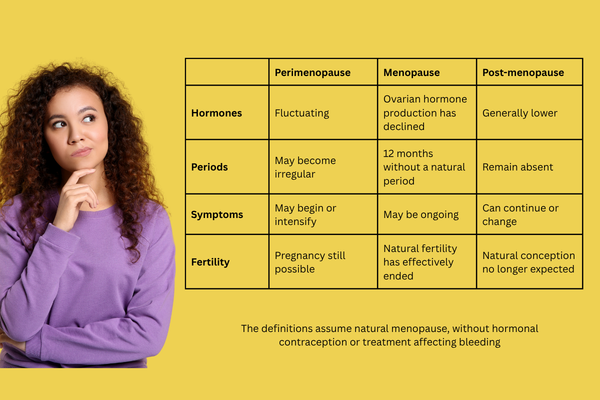
Let’s start with one thing and let’s make that clear — while ‘the menopause’ has for many come to mean the whole period of transition, menopause itself is actually a point in time, rather than a prolonged stage of life.
Technically, menopause is identified retrospectively, once a woman has gone 12 consecutive months without a natural menstrual period, provided there isn't another explanation, such as hormonal contraception. The final menstrual period itself marks the point of menopause, but you can only confirm that point once those 12 months have passed. [1,2]
In the years leading up to menopause, a woman may experience perimenopause — the transitional phase during which hormones and menstrual cycles begin to change. Once menopause has occurred, she enters postmenopause, which continues for the rest of her life. [2]
In the UK and most other Western countries, the average age a woman reaches menopause is around 51, although natural menopause typically occurs somewhere between 45 and 55. [3]
Menopause is associated with a significant fall in naturally occurring oestrogen, but in the perimenopause years beforehand, oestrogen levels can fluctuate wildly. These hormonal changes contribute to many of the symptoms we associate with the menopause transition: hot flushes, changing periods, disturbed sleep, unpredictable moods and more. [4,5]
Perimenopause symptoms can begin several years before menopause, sometimes considerably earlier, while there’s no definite cut-off afterwards, unfortunately. Symptoms can continue for months and years into postmenopause. [5,6]
In fact, one large study following women through the menopause transition found that those experiencing frequent hot flushes and night sweats had these symptoms for a median of 7.4 years. Among women whose final menstrual period could be identified, symptoms continued for a median of 4.5 years afterwards. [6]
Of course, these figures relate specifically to hot flushes and night sweats, not every possible menopause symptom. But they help illustrate why menopause isn't simply a case of reaching a certain point and suddenly feeling better.
What's happening to your hormones during perimenopause and menopause?
Oestrogen and progesterone play important roles in regulating a woman’s menstrual cycle. Oestrogen helps build up the lining of the womb, while progesterone rises after ovulation and helps prepare that lining for a possible pregnancy. If pregnancy doesn't occur, hormone levels fall and a period follows. [7]
As women approach menopause, hormonal production via the ovaries becomes less predictable. Ovulation may happen less frequently, meaning progesterone production can become more irregular. Meanwhile, oestrogen doesn't simply decline in a nice, steady line. Levels can fluctuate considerably, sometimes rising higher than they did earlier in a woman's reproductive life. [4]
Following menopause, the ovaries produce much less oestrogen and very little progesterone. Although the body continues to produce small amounts of oestrogen elsewhere, the overall hormonal environment has changed. [4]
Importantly, these hormones influence more than just the menstrual cycle. Oestrogen plays a role in temperature regulation, vaginal and urinary health, and processes affecting sleep and mood.
This helps explain why hormonal changes during perimenopause and menopause can produce such a wide variety of symptoms, although it's worth remembering that not every physical or emotional change in midlife can automatically be attributed to hormones. [4,5]
What are the signs and symptoms of perimenopause and menopause?
This is where things get tricky as there is no set of symptoms that are confined to one stage. Here are some of the things that may occur during the menopause transition. [5]
Menstrual: Irregular periods, heavier or lighter bleeding, changing cycle length.
Physical: Hot flushes, night sweats, joint and muscle discomfort, headaches.
Cognitive and emotional: Brain fog, difficulties concentrating, anxiety, mood changes.
Sleep and energy: Difficulty sleeping, night waking and fatigue.
Sexual and urinary: Vaginal dryness, discomfort during sex, urinary symptoms and libido changes.
Symptoms can begin before menstrual changes become obvious, which can add to the confusion. Some women experience very few symptoms, while others have a significant symptom load.
Other factors can also produce overlapping symptoms. These include thyroid disorders, medication, stress and sleep problems. [1,5]
Over the years, women have reported an ever-growing list of potential menopause symptoms. We talk about them in this episode of our podcast.
Episode 99: Is That Really A Menopause Symptom?
How do you know if you're in perimenopause or menopause?
Clinicians will look at your menstrual history, age and symptoms to try and establish a clinical picture. But it’s worth noting that having regular periods doesn’t mean you won't experience perimenopausal symptoms.
The truth is, there’s no reliable way of predicting precisely when your final period will occur — and if you are wondering about testing, check out the section below.
For most otherwise healthy women aged 45 and over, clinicians can identify perimenopause or menopause from symptoms and menstrual history without routinely needing hormone tests.
Finally, early menopause (before 45) and suspected premature ovarian insufficiency (before 40) need particular medical attention, as the health implications and management can differ from those of menopause occurring at the usual age. [1,2]
What if you're taking hormonal contraception — particularly the Mirena coil?
This is a question we are asked all the time. The Mirena coil releases a progestogen — a synthetic hormone that acts on progesterone receptors in the body — and can make periods lighter or stop them completely. [8]
Of course, this challenges the whole medical assessment of menopause. If a woman has not had a period for several years because of the Mirena coil, the usual 12-month rule goes out of the window. The absence of periods doesn't necessarily mean menopause has occurred. [1,9]
Other hormonal contraceptives, including the progestogen-only pill and combined pill, can also muddy the waters. Some affect bleeding patterns, while others may mask certain menopausal symptoms. [9]
Having said that, many women can still notice perimenopausal symptoms even when their menstrual pattern is masked by contraceptives.
The key thing here is that while contraception may make it harder to establish whether menopause has occurred, that doesn’t prevent you from seeking advice.
It's also worth remembering that contraception may still be necessary during perimenopause. Even if your periods have stopped, that doesn't necessarily mean pregnancy is impossible.
If you are looking for clarity, chat to your doctor about your concerns and whether your contraception is still appropriate for you. [9]
Can you test for perimenopause or menopause?
Given that hormone levels can fluctuate so much in perimenopause, testing the hormones you might expect, such as oestrogen and progesterone, can produce results that are difficult to interpret.
Tests are also available for follicle-stimulating hormone (FSH). This hormone signals the ovaries to develop follicles and produce oestrogen during a woman's reproductive years. As menopause approaches and the ovaries become less responsive, FSH levels generally rise. However, these levels can also fluctuate considerably during perimenopause. [4]
For this reason, routine FSH testing is not recommended to identify menopause in otherwise healthy women aged 45 and over.
Tests may, however, be used for women aged 40–45 with suspected early menopause or those under 40 with suspected premature ovarian insufficiency. [1]
There are also particular circumstances where testing may be useful for women using hormonal contraception. For example, women over 50 who have stopped having periods while using certain progestogen-only contraceptives, including the Mirena coil, may be offered an FSH test to help guide decisions about when they can safely stop contraception.
Importantly, this doesn't mean the test can establish precisely when menopause occurred. [9]
The truth is that for most women over 45, doctors can make decisions about menopause treatment, including hormone replacement therapy (HRT), based on symptoms, medical history and individual circumstances rather than routine hormone tests. [1,10]
It’s also worth noting that home menopause testing kits leave a significant gap: there's a difference between measuring a hormone accurately and interpreting what that result actually means.
A single result cannot necessarily tell you where you are in the menopause transition, particularly when hormone levels are changing from one day or cycle to the next.
If you want to hear a more detailed conversation about testing for menopause, check out this episode of our podcast.
Episode 98: Can You Test for Menopause?
What does menopause mean for your long-term health?
Oestrogen is much more than a hormone involved with sex and reproduction. It plays an important role in several aspects of a woman's health, and declining levels around menopause can have implications that extend beyond the symptoms we commonly associate with the transition.
These include: [3,11]
Bone health: Oestrogen helps maintain bone density, so declining levels during menopause can accelerate bone loss and increase the risk of osteoporosis and fractures. This makes adequate nutrition, weight-bearing activity and resistance exercise particularly important.
Cardiovascular health: The risk of cardiovascular disease generally increases as women get older. Changes associated with menopause can affect factors such as cholesterol, blood vessel function and fat distribution, although ageing, genetics and lifestyle also play important roles. Keeping an eye on blood pressure, cholesterol and other cardiovascular risk factors is therefore worthwhile.
Muscle mass and strength: Muscle mass and strength tend to decline with age, and hormonal changes may contribute to changes in muscle function and body composition. Maintaining muscle through strength training and appropriate nutrition is increasingly important for mobility, metabolic health and independence later in life.
Body composition: Some women notice that fat becomes more concentrated around their abdomen during and after menopause. Hormonal changes can contribute to this shift, but changes in body weight and composition are also influenced by activity levels, muscle mass, diet, sleep, genetics and ageing. It's rarely as simple as blaming everything on oestrogen.
Metabolic health: Changes in body composition and hormonal status may influence insulin sensitivity and how the body manages glucose and fat. Maintaining a healthy lifestyle and monitoring relevant risk factors can help support metabolic health over the longer term.
It would be wrong to say that menopause inevitably causes poor health in later life, but it is an important life stage and one where it’s a good idea to review any long-term health priorities you may have.
And there's plenty that can be done to support those priorities.
What can you do to support your health through perimenopause and menopause?
Here are some things you might want to focus on during the menopause transition — many of which we can actually help with here at Fabulous Beyond 40, as getting the support of a nutritionist, health coach or personal trainer can complement appropriate medical treatment. [1,11,12]
Nutrition: Adequate protein, fibre, calcium, vitamin D and a balanced dietary pattern.
Movement: Strength training, cardiovascular activity and maintaining daily movement.
Sleep: Addressing sleep disturbances and considering possible triggers or underlying contributors.
Stress: Recognising the effects of life demands and developing realistic ways to manage them.
Individualisation: Not everyone needs the same interventions, and attempting to change everything at once is rarely sustainable.
Medical treatment: HRT and non-hormonal treatments may be appropriate depending on symptoms, medical history and personal preferences.
The important thing to remember is that there isn't one approach that works for every woman. What matters is identifying the areas that could make the greatest difference to your own health and circumstances, rather than feeling you need to change everything at once.
When should you speak to your doctor?
Seek help from your doctor when:
Symptoms affect work, relationships, sleep or quality of life.
Menopause-like symptoms occur before 45, particularly before 40.
Menstrual bleeding is unusually heavy, persistent or concerning.
Bleeding occurs after 12 months without natural periods, even if it's only a small amount.
You experience unexpected or persistent bleeding while using HRT or hormonal contraception.
You are uncertain about contraception, HRT or possible alternative explanations for symptoms.
[1,5,13]
You may find recording your symptoms and menstrual patterns useful when you speak to your doctor. The more information they have, the easier it is for them to have a clear clinical picture of what may or may not be going on.
Can you still get pregnant during perimenopause?
Yes. Fertility declines, but ovulation and pregnancy remain possible. That means contraception is still important if you don't want to become pregnant. It's also worth remembering that HRT is not contraception. [9,12]
Can you experience perimenopause symptoms while still having regular periods?
Yes. Hormonal changes and symptoms may begin before periods become noticeably irregular. Having regular periods doesn't automatically rule out perimenopause. [4,5]
Can you start HRT during perimenopause?
Yes. Women don't necessarily need to wait until their periods have stopped. If symptoms are affecting your quality of life, you can discuss HRT and other treatment options with an appropriate healthcare professional. [10]
You don't need to know exactly where you are to start looking after yourself
Perimenopause, menopause and postmenopause are distinct stages, but the boundaries aren't always easy to recognise. Some women can identify menopause through their menstrual history; others, particularly those using hormonal contraception, can't.
Understanding symptoms, recognising changes and accessing appropriate support matter more than obtaining an exact label. There is no single approach that works for every woman.
Want a good point to start from a lifestyle perspective? Take our free Midlife Health Check-In quiz to get a broader look at your health and where you might need support.
References
National Institute for Health and Care Excellence. Menopause: identification and management. NICE guideline NG23 [Internet]. London: NICE; 2015 [updated 2026 Apr 15; cited 2026 Nov 9]. Available from: https://www.nice.org.uk/guidance/ng23/chapter/Recommendations
NHS. What are menopause and perimenopause? [Internet]. NHS; 2026 [cited 2026 Nov 9]. Available from: https://www.nhs.uk/conditions/menopause-and-perimenopause/what-are-menopause-and-perimenopause/
University College London Hospitals NHS Foundation Trust. Understanding menopause [Internet]. London: UCLH; [cited 2026 Nov 9]. Available from: https://www.uclh.nhs.uk/patients-and-visitors/patient-information-pages/understanding-menopause
Roeca C, Al-Safi Z, Santoro N. The postmenopausal women. In: Feingold KR, et al., editors. Endotext [Internet]. South Dartmouth (MA): MDText.com, Inc.; 2000– [updated 2025 Sep 30; cited 2026 Nov 9]. Available from: https://www.ncbi.nlm.nih.gov/books/NBK279050/
NHS. Symptoms of menopause and perimenopause [Internet]. NHS; 2026 [cited 2026 Nov 9]. Available from: https://www.nhs.uk/conditions/menopause-and-perimenopause/symptoms/
Avis NE, Crawford SL, Greendale G, Bromberger JT, Everson-Rose SA, Gold EB, et al. Duration of menopausal vasomotor symptoms over the menopause transition. JAMA Intern Med. 2015;175(4):531-539. doi:10.1001/jamainternmed.2014.8063. Available from: https://pubmed.ncbi.nlm.nih.gov/25686030/
NHS. Periods and fertility in the menstrual cycle [Internet]. NHS; [cited 2026 Nov 9]. Available from: https://www.nhs.uk/conditions/periods/fertility-in-the-menstrual-cycle/
NHS. Side effects and risks of an IUS (intrauterine system) or hormonal coil [Internet]. NHS; 2024 [cited 2026 Nov 9]. Available from: https://www.nhs.uk/contraception/methods-of-contraception/ius-hormonal-coil/side-effects-and-risks/
Faculty of Sexual & Reproductive Healthcare. Contraception for women aged over 40 years. FSRH guideline [Internet]. London: FSRH; 2017 [amended 2025 May; cited 2026 Nov 9]. Available from: https://www.fsrh.org/Common/Uploaded%20files/documents/fsrh-guideline-contraception-for-women-aged-over-40-years.pdf
NHS. When to take hormone replacement therapy (HRT) [Internet]. NHS; [cited 2026 Nov 9]. Available from: https://www.nhs.uk/medicines/hormone-replacement-therapy-hrt/when-to-take-hormone-replacement-therapy-hrt/
Panay N, Fenton A, Hamoda H, Hillard T, Islam R, Pedder H, et al. International Menopause Society (IMS) recommendations and key messages on women's midlife health and menopause. Climacteric. 2025;28(6):634-656. doi:10.1080/13697137.2025.2585487. Available from: https://pubmed.ncbi.nlm.nih.gov/41433054/
NHS. Things you can do to help menopause and perimenopause symptoms [Internet]. NHS; [cited 2026 Nov 9]. Available from: https://www.nhs.uk/conditions/menopause-and-perimenopause/things-you-can-do/
NHS. Postmenopausal bleeding [Internet]. NHS; [cited 2026 Nov 9]. Available from: https://www.nhs.uk/symptoms/post-menopausal-bleeding/


